 Main:
Main: 

As a specialty dental practice owner or leader, you navigate a complex landscape of patient care, staff management, and financial oversight. It’s easy to view technology as a necessary but cumbersome expense...another line item on a budget crowded with payroll, supplies, and facility costs.
But here’s the thing: that perspective overlooks a critical truth.
Strategic technology is not a cost center; it's one of the most powerful financial assets you can leverage.
Outdated or poorly managed dental practice technology quietly drains resources. It creates workflow inefficiencies, frustrates your highly-trained staff, and, most alarmingly, exposes your practice to significant financial and reputational risks. In the world of specialty dentistry—where precision, speed, and trust are paramount—your IT infrastructure is the bedrock of your operational and financial success.
This article explores three essential tech upgrades that deliver a direct and measurable return on investment (ROI). By embracing these advancements in dental office IT solutions, you can enhance profitability, strengthen security, and build a more resilient and efficient practice for the future.
Dental Tech Upgrade #1: Modernize Your Network, Wi-Fi, and Internet Connection
The backbone of any growth-minded dental practice is its network. It’s the central nervous system that connects your front desk, operatories, imaging equipment, and business office. When it’s slow or unreliable, everything downstream pays the price.
Hidden Costs of a Slow Network
You’ve probably felt this before, even if you didn’t name it as a “network issue”:
- Staff waiting for large DICOM files or CBCT scans to load
- Front office teams stalled while checking in patients, submitting insurance, or processing payments
- Choppy Wi-Fi in the waiting area, annoying patients and affecting the “morning vibes playlist” on your music system
- Imaging software freezing mid-consult, derailing your schedule
These “small” delays stack up:
- Fewer patients seen per day
- Overtime needed to “catch up”
- Hold-ups in billing, claims, and collections
- Rising staff stress and burnout
Over time, that “kind of slow” network quickly erodes production and drives up costs.
Common Issues We See
- Internet speeds that were “fine” 5 years ago can’t keep up with today’s imaging, VoIP, and cloud tools.
- Practices stuck in ISP contracts where they’re paying for speeds they rarely see in real life.
- Shared circuits that slow to a crawl when the neighborhood is busy, bringing your systems down with them.
- New operatories or locations added without reevaluating whether the current internet connection can actually support the growth.
Most traditional IT companies stop at the firewall. They’ll replace your router, but they won’t dig into your carrier options, contracts, or how your internet is really performing day to day.
ROI of a Seamless Connection
Investing in a reliable, high-speed network and robust Wi-Fi infrastructure is one of the most immediate ways to improve dental practice profitability. The ROI is clear:
- Increased Efficiency: Faster access to patient records, imaging files, and practice management software allows your team to see more patients and complete tasks in less time.
- Enhanced Imaging Speeds: Seconds saved on loading a 3D CBCT scan translate into minutes saved per patient, improving chairside efficiency and the patient experience.
- Improved Staff Morale: A seamless tech experience empowers your team to work at their peak, reducing frustration and improving retention.
Pact-One's Approach: Network + Communications, Working Together
Unlike traditional IT providers, Pact-One doesn’t look at your network in isolation. We partner with a dedicated communications group whose entire focus is optimizing internet and carrier services for practices like yours.
Together, we:
- Assess Your Network & ISP
- Benchmark current network performance, Wi-Fi coverage, and bandwidth usage
- Review your existing ISP contract, speeds, and service reliability
- Identify Obstacles & Opportunities
- Determine whether your bandwidth matches your imaging and cloud usage
- Pinpoint if you’re overpaying for underperforming service
- Recommend redundancy or carrier changes where needed
- Right-Size Your Internet Service
- Through our communications group partner, we compare multiple carriers and packages to help you secure the right connection for your growth—often at a better value than what you’re paying now.
- Design a Dental-Optimized Network
- With the right internet foundation in place, Pact-One designs and implements a network built for specialty dentistry:
- Business-grade firewalls, switches, and access points
- Separate, secure Wi-Fi for staff, guests, and clinical systems
- Prioritized traffic for imaging, VoIP, and practice management software
Our goal: a fast, stable, and secure network where your internet connection and internal infrastructure are working together.
Dental Tech Upgrade #2: Implement Advanced Cybersecurity & HIPAA Compliance
(Your Highest-Stakes Upgrade)
If there’s one area of IT where “good enough” can sink your entire practice, it’s cybersecurity.
Your network can be a little slow, and you’ll lose efficiency. Your backups can be outdated, and you’ll be in trouble if disaster hits. But if your security fails, you’re facing all three at once: downtime, data loss, and a full-blown compliance crisis.
This is the upgrade with the highest stakes...and the highest potential ROI.
What You're Really Up Against (Beyond Basic Antivirus)
Cyber threats against healthcare aren’t abstract headlines; they’re a daily reality. Dental practices are appealing targets because attackers assume:
- You hold highly sensitive, high-value data
- You have compliance obligations (HIPAA)
- You’re less protected than hospitals or large health systems
Common attack paths include:
- Ransomware: Encrypts your data and systems, demanding payment for a decryption key
- Business Email Compromise (BEC): Spoofed or compromised email accounts used to steal money or patient information
- Phishing & Social Engineering: Staff tricked into clicking malicious links, giving away passwords, or approving fraudulent payments
- Exploited Vulnerabilities: Outdated software, unpatched servers, or insecure remote access tools used as entry points
Any one of these can halt clinical operations and trigger an expensive, public incident.
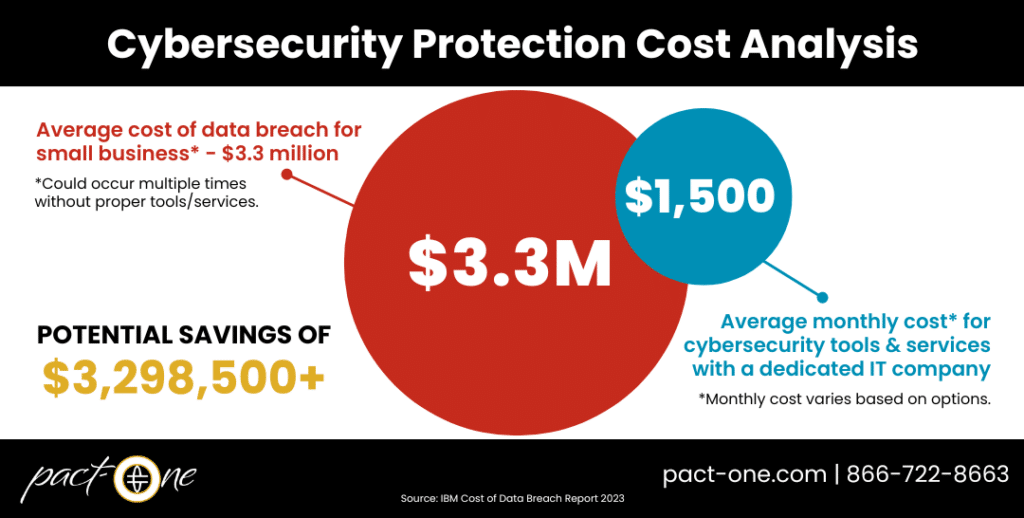
Real Cost of a Breach of Major Incident
A serious incident can be staggering and result in tens of thousands of dollars in lost revenue due to:
- Extended Downtime: lost production every hour your systems are offline
- HIPAA & Regulatory Fallout: required notifications, potential OCR investigations, land you on the “wall of shame”, and fines
- Recovery & Remediation Costs: forensic investigations, emergency IT rebuilds, hardware replacement, and consulting fees
- Reputation Damage: loss of trust with patients and referral partners that’s hard to repair
Effective dental cybersecurity is non-negotiable. It’s core to protecting both your balance sheet and your brand.
Cybersecurity as a Profit & Valuation Protector
Think of cybersecurity and compliance as a protective shield around your revenue, reputation, and practice valuation.
You see ROI through:
- Fewer incidents --> more uptime and steadier production
- Lower risk profile --> stronger valuation in any future sale or partnership
- Reduced “unknowns” --> better planning and fewer surprise emergencies
- Patient & partner confidence --> stronger growth and stickier referral relationships
How We Safeguard America's Top Dental Practices
As guardians of your practice's most sensitive data, we consider dental cybersecurity to be our most critical responsibility. At a glance, strong cybersecurity for dental practices comes down to a multi-layered approach.
Rather than handing you a stack of security tools, Pact-One implements advanced network security as a unified program—where the best cybersecurity technology and real humans (certified cybersecurity specialists) work together 24/7/365 to catch threats early and block them before they turn into downtime or a breach.
What does that look like in real life?
- Malware stopped before it spread
When a team member at a specialty practice accidentally clicked a malicious email link, our endpoint protection and monitoring flagged unusual encryption behavior within minutes. We isolated the affected machine, rolled it back using a clean restore point, and kept the rest of the network—and the schedule—running without interruption. - Stolen password, no stolen data
In another practice, an attacker tried to log in from an unexpected location using a compromised password. Because of the tools and security experts we have in place, the access attempt was blocked, the account was locked down, and our team walked the client through a quick credential reset and staff refresher—no data accessed, no reportable breach. - Phishing attempt turned training moment
At a multi-location group, several staff members received convincing “payment update” emails that looked like they came from a vendor. Our email security tools caught most of them; one was reported by a trained team member. Instead of an incident, it became a real‑time phishing training opportunity for staff members provided by our in-house security expert.
Is your practice truly secure? Don’t leave your patient data and financial health to chance. Evaluate your security risk by scheduling your complimentary Practice IT Analysis with a Pact-One specialist today!
Dental Tech Upgrade #3: Deploy a Backup & Disaster Recovery Solution
If your network is the nervous system of your practice and your data is the lifeblood, then your backup and disaster recovery (BDR) plan is the life-support system.
Many practices assume “we’re backed up” because a server runs a nightly job, or there’s an external hard drive plugged in somewhere. But this can be a dangerously expensive assumption, considering:
- Ransomware attacks are estimated to occur every 2 seconds by 2031, according to Cybercrime Magazine.
- Hardware failure (server, computer, network switches, etc.) affects a considerable percentage of dental practices each year.
- Extreme weather incidents (hurricanes, tornados, flooding, wildfires, etc.) continue upward trend with the annual average of billion-dollar disasters reaching 23 over the most recent 5 years (2020-2024) in the U.S.
Hidden Risk of "Set-It-and-Forget-It" Backups
On paper, you may have a backup. In reality, we often find:
- Single points of failure (one on-premise server or USB drive in the same building)
- Backups that don’t restore (never tested, incomplete, or corrupt)
- Slow recoveries (days of downtime while systems are rebuilt from scratch)
- No documented recovery plan (no one’s sure what to do or who to call during a crisis)
The financial impact of a serious outage or data-loss event can include:
- Lost production every hour your team can’t access imaging or your practice management system
- Overtime and chaos as staff reschedules patients and recreates records
- Compliance exposure if backups aren’t encrypted or handled properly
- Ransom payments or emergency recovery fees if you’re hit with ransomware
When every hour of chair time matters, waiting days to get back up and running just isn’t acceptable.
ROI of a Proper BDR Solution
A strong backup and disaster recovery strategy delivers ROI by protecting revenue, time, and reputation:
- Minimized Downtime: Image-based backups and onsite virtualization can have you back in operation within hours instead of days.
- Ransomware Resilience: Immutable, versioned backups allow you to roll back to a clean, recent state...often avoiding ransom payments entirely.
- Predictable Recovery: Clearly defined recovery time (RTO) and recovery point (RPO) objectives mean fewer surprises and better planning.
- Compliance & Reputation Protection: Encrypted, monitored, and documented backups aligned with HIPAA expectations help protect both your practice and your public image.
Check out ‘Best-in-Class Backup & Recovery Strategies for Dental Offices’ to get a step-by-step blueprint, learn common mistakes to avoid, and how to make data backup a priority.
How Pact-One Designs BDR for Dental Specialists
Pact-One builds BDR strategies around the reality of busy dental practices:
- Risk Assessment
We audit your current backups, storage locations, encryption, and restore capabilities, then clearly show you where the risks are. - Right-Sized Plan
We design a BDR solution that fits your production volume and regulatory requirements...defining backup frequency, storage locations, and recovery objectives. - Implementation & Monitoring
Our team configures, monitors, and maintains your backups 24/7 and performs test restores on a schedule, so you’re not flying blind. - Hands-On Recovery Support
If disaster strikes, we stand shoulder-to-shoulder with your team to execute the recovery plan and get you back to treating patients as quickly as possible.
A few months ago, a dental office in California called us in a panic. A pipe had burst over the weekend, flooding their office and destroying their local hardware. By Monday morning, they couldn’t access patient charts, imaging, or schedules. Thanks to an offsite encrypted backup (stored in the cloud), we had them operational again within hours.
Choosing Your Dental Technology Partner
These upgrades (network optimization, advanced security, and BDR) are not DIY projects. They also aren’t something you want handled by a traditional IT company or “IT guy” who supports everyone from coffee shops to car dealerships.
Dental practices have unique needs:
- Massive imaging files and complex workflows
- Tight integrations between specialty software and practice management systems
- HIPAA and healthcare-specific cyber threats
- Direct, immediate revenue impact from even minor downtime
Pact-One exists specifically to serve dental.
We don’t just fix what’s broken. We design IT that supports your growth, protects your revenue, and gives your team the stability they need to deliver exceptional care.
With a nationwide footprint and a people-first mindset, we bring enterprise-level expertise while still showing up like a local partner.
Secure Your Practice's Future and Financial Health with Pact-One
Your technology shouldn’t be a constant source of frustration or “just another expense.” It should be a powerful engine that helps your practice grow.
By:
- Modernizing your network, Wi‑Fi, and internet connection
- Fortifying your cybersecurity and compliance posture
- Deploying a reliable backup and disaster recovery strategy
…you can protect your practice, increase efficiency, and unlock real financial ROI from your IT investments.
Ready to turn your technology into a profit center instead of a cost center Schedule a no-obligation consultation with Pact-One to map out your IT roadmap and ROI opportunities.
FAQs: Technology ROI & Risk for Specialty Dental Practices
How do I know if my current backups are enough?
If you haven’t tested a full restore in the last 6–12 months, assume there are risks. In our assessments, we routinely find “backups” that are inadequate (external hard drive, legacy systems), failing silently, or can’t restore critical systems when it matters most.
What’s a reasonable recovery time for a dental practice?
It depends on size and complexity, but most specialty practices should target recovery times measured in hours, not days. Your specific recovery time objective (RTO) should be defined and documented.
Isn’t all of this overkill for a single-location practice?
Single-location practices are often prime targets because attackers assume weaker defenses. One successful attack—or a single server failure—can cost far more than a proactive security and BDR strategy. We’re talking about $875/hour (downtime) vs. $1.65/hour (IT services including data backup).
What’s the best first step if I’m unsure where to start?
Begin with a focused assessment. From there, we prioritize quick, high-impact improvements—like stabilizing your network or validating your backups—before moving into long-term planning.
Dental IT. Remove the Burden. Embrace the Use.
Quality patient care – it's ultimately why you became a dental professional. But, some business operations can get in the way (such as pesky computer issues or lack of IT support). That’s where Pact-One Solutions can help! Our passion lies in supplying reliable, responsive dental IT support and security that practices can count on.
Whether you’re looking for dental IT services for your startup or searching for more responsive dental IT support – our team of dental IT specialists have you covered. With team members throughout the United States, we offer nationwide support to dental practices of all sizes, specialties, and stages of growth. Our wide range of dental IT services ensure your data is secure, accessible, and protected.
Don't let technology challenges hinder your ability to deliver exceptional dental care. Contact us at info@pact-one.com or 866-722-8663 to join over 3,000 dental professionals thriving with the support of a dedicated dental IT team.


You must be logged in to post a comment.