 Main:
Main: 
Last Updated: August 2026
For the 2026 tax year, dental practices can deduct up to $2,560,000 in qualifying technology and equipment purchases under Section 179, with the deduction phasing out once total purchases exceed $4,090,000. Equipment and software must be purchased or financed and placed into service by December 31, 2026.
You know your practice needs it. The imaging workstation that hangs for ten seconds every time someone pulls up a full-mouth series. The server that’s carry the load of the practice on its shoulders. The front desk PC that makes your team apologize to patients while it “thinks.”
You also know what new equipment costs. And that's usually where the plan stalls, because writing a check that big feels like it should wait for a better year.
But it doesn't have to be all-or-nothing, and it doesn't have to come entirely out of this year's cash flow. Between how you finance a purchase, how you sequence it, and a piece of the tax code built almost for exactly this situation, there's a real path to modern, reliable technology that doesn't blow up your budget. Let's walk through it with Section 179 front and center, since it's the biggest lever most practices leave on the table.
Why "Wait Unit Next Year" Ends Up Costing More
It's an easy trap. Nobody wants to spend $60,000 on servers and workstations when the current setup is "still working"… even if "working" means restarts, workarounds, and a staff that's learned to route around the slow machine in the corner.
But the longer aging technology stays in service, the more it costs you:
- Lost chair time when imaging or charting lags during patient hours
- Compounding risk as unsupported operating systems and unpatched software become easier targets for ransomware
- Bigger bills later when a single failure forces an emergency, same-week replacement instead of a planned one
The practices that stay ahead of this aren't the ones with the biggest IT budgets, they're the ones who plan the spend, time it well, and use every legitimate tool available to shrink the cost. That's where the next few sections come in.
3-Step Plan for Funding Your Dental Practice's Next Technology Upgrade
1. Know Exactly What You're Replacing and Why
Before any purchase, get a view of your current environment. The age and warranty status of every workstation and server, which operating systems are approaching end of support, and where your network or backup setup is genuinely a liability versus just old. A Practice IT Analysis does exactly this and hands you a prioritized list instead of a guess. It also means every dollar you spend goes toward something that moves the needle.
2. Let the Tax Code Do Some of the Heavy Lifting - Section 179
Once you know what you're buying, the tax code can do a lot of the heavy lifting on cost. This is the biggest piece of the puzzle, so it gets its own section below.
3. Time the Purchase, and Phase It if It's Big
Section 179 rewards equipment that's purchased and placed into service within the same calendar year, so timing matters. For a full technology overhaul, a phased approach — stabilize the highest-risk items first, then standardize, then optimize, a framework we walk through step-by-step in our guide to replacing dental practice technology — spreads the spend across the pieces that matter without leaving you facing everything at once in December.
What is Section 179, and How Does it Help Dental Practice?
Section 179 of the IRS tax code lets a dental practice deduct the full purchase price of qualifying equipment and software in the same year it's placed into service, instead of depreciating that cost over five or seven years. It’s a meaningful difference in your practice's cash flow because the tax benefit shows up now, not spread thin over the better part of a decade.
Fast facts for the 2026 tax year:
- Maximum deduction: up to $2,560,000 in qualifying purchases
- Spending cap: the deduction begins phasing out dollar-for-dollar once total qualifying purchases exceed $4,090,000
- Deadline: equipment and software must be purchased (or financed) and placed into service by December 31, 2026
- New or used equipment both qualify, as long as it's new to your practice
- Business-use requirement: equipment generally needs to be used more than 50% of the time for your practice
For nearly every private practice, orthodontic office, or even a multi-location group, that $2,560,000 ceiling is nowhere close to being a limiting factor which means Section 179 is realistically available to you, not just to large DSOs.
What Equipment and Software Qualify for Section 179?
Most of what you'd already be budgeting for as a "technology refresh" qualifies, including:
- Computers, servers, and networking equipment (firewalls, switches, access points) that support your network security
- Digital X-ray machines, intraoral cameras, and 3D imaging or printing equipment
- Backup and disaster recovery appliances
- Off-the-shelf practice management or imaging software (think Dentrix, Eaglesoft, Open Dental, or similar platforms) as long as it's commercially available (not custom-built), used more than half the time for business, and new to your operations
- Office furniture and fixtures
How Much Can You Save with Section 179?
Section179.org's free Section 179 Calculator is built to help you see how much your dental practice could save on specific technology purchases. Just plug in what you're planning to spend, and it estimates your savings. To illustrate, let’s take an example of replacing approximately four (4) computers and a server with equipment costing $17,040. By leveraging the Section 179 Deduction, the true cost of equipment (whether purchased, financed, or leased) drops to $11,076. That’s a savings of $5,964.
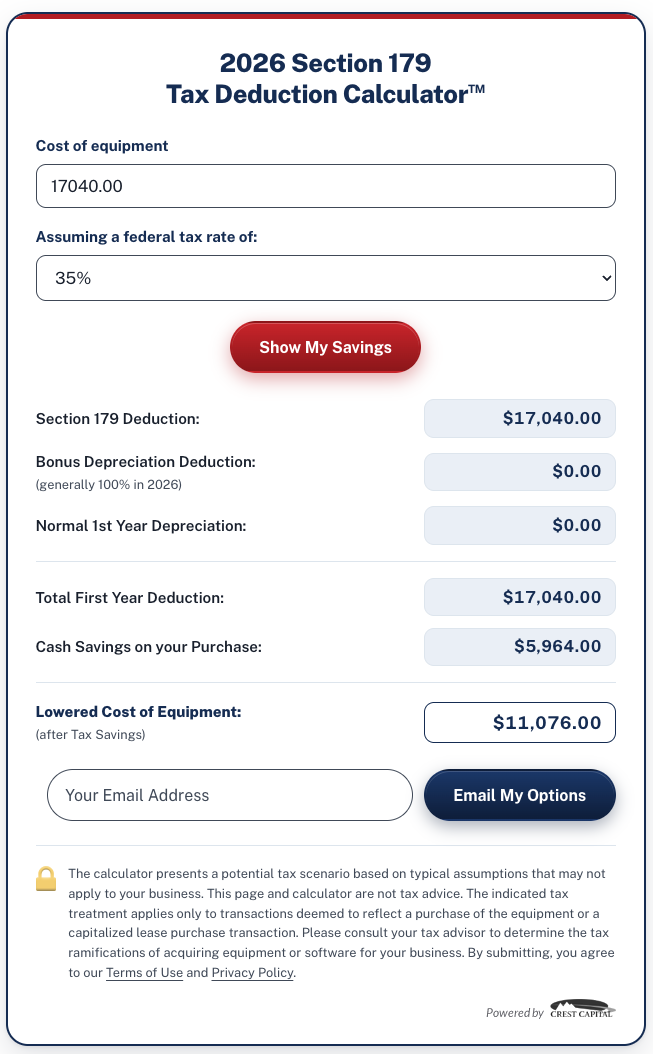
This is an example result of a small technology refresh (4 computers and 1 server).*
*Illustrative only. Your actual savings depend on your tax bracket, eligibility, and equipment (equipment pricing in this example is subject to change due to price volatility within the technology hardware market). Run your own numbers with the calculator and confirm with your tax advisor before you buy.
Can You Finance Equipment and Still Take the Section 179 Deduction?
Yes. One thing that trips people up is you don’t to pay cash to claim the deduction. Equipment financing agreements, capital leases (with a $1 purchase option), and loan agreements all qualify. You can finance the purchase, keep more cash on hand, and still take the full Section 179 deduction the same year. Operating leases with a fair-market-value of 10% purchase option at the end don’t qualify, so it’s important to confirm the structure of any lease before you sign.
Checklist: Are You Set Up to Take Full Advantage this Year?
- You have an up-to-date inventory of what needs replacing and why
- You know your practice’s approximate tax bracket, so the calculator number reads more accurate
- You’ve talked to your CPA about how Section 179 and bonus depreciation apply to your situation
- Your purchases will be placed into service, not just ordered, before December 31
- You’ve decided whether to pay cash, finance, or lease (and confirmed the lease type qualifies)
- You’re prioritizing high-impact, high-risk items (such as Sever 2016, or Windows 10 computers) first if this is a larger, phased upgrade
If most of these are checked, you’re in a strong position to make this year’s technology investment work harder for your practice than it costs it.
Let's Build Your Dental Practice Technology Plan Together
You didn’t get into dentistry to become a tax code or technology expert. We’re here to help! Pact-One can give you a clear, prioritized view of what to replace and when so when you sit down with your accountant about Section 179, you’re working from a real place instead of a guesstimate.
Talk to a Dental IT Specialist and let’s map out what your practice needs before the year closes out.
Prefer to run your own numbers first? Try the Section 179 Calculator and see what your next upgrade could cost.
Disclaimer: This article is designed to deliver general information and should not be taken as legal, financial, or tax advice. The intricacies of Section 179 and its applicability can differ significantly across various business scenarios. It’s crucial to see guidance from a qualified financial advisor or tax consultant tailored to your unique business needs before making decisions that could affect your dental practice’s tax liabilities or financial standing.
Despite diligent efforts to maintain the accuracy and up-to-date nature of this content, tax regulations, eligibility criteria, and the nuances of Section 179 are subject to change without prior notification. For the latest and most relevant information, consulting with a professional tax advisor is strongly recommended.
Sources
- org, “2026 Section 179 Deduction Guide,” https://www.section179.org/. Accessed 20 August 2026.
- Pact-One Solutions, “IRS Tax Code Section 179 2026 Equipment & Technology Credit,” https://www.pact-one.com/learning-hub/section-179/. Accessed 20 August 2026.
Dental IT. Remove the Burden. Embrace the Use.
Pact-One takes IT completely off your plate – cybersecurity, data backup & recovery, and day-to-day technical support – so you can get back to running your practice. Dental IT exclusively since 2003.
Contact us at info@pact-one.com or 866-722-8663 to join 3,000+ dental professionals thriving with the support of a dedicated dental IT team.


You must be logged in to post a comment.